
How can boards best help guide companies through the competitive dynamics unleashed by AI?
Artificial intelligence—including its many offspring, from machine learning models to AI agents—is much more than the latest wave of technology. It is a general-purpose capability that is poised to touch almost every sector, function, and role, with the power to reshape how companies compete, operate, and grow. With trillions of dollars potentially at play and implications that could be existential to companies, AI is closer to a reckoning than a trend. And that is why AI is a board-level priority.
More than 88 percent of organizations report using AI in at least one business function1; however, board governance has not matched that pace. While interest in AI seems to have spiked after the introduction of ChatGPT, as of 2024, only 39 percent of Fortune 100 companies disclosed any form of board oversight of AI—whether through a committee, a director with AI expertise, or an ethics board.2
Even more telling, a global survey of directors found that 66 percent report their boards have “limited to no knowledge or experience” with AI, and nearly one in three say AI does not even appear on their agendas.3
Having a low rate of AI adoption by boards might seem obvious at first, given the often-sizable investments many companies have already made in AI and the limited returns to date. AI adoption has not yet led to significantly improved performance for most businesses, with companies reporting modest levels of savings and new revenue.4
In our experience, however, many of the issues plaguing AI programs—such as a lack of strategic coherence and unclear value dynamics—are precisely the ones that boards are best positioned to address. In other words, boards have an important role to play in redressing the disappointing outcomes.
That role is grounded in developing a strong understanding of how AI can change the business, both for better and for worse. Boards, therefore, need to become fluent in AI, not necessarily as a technology, but as a catalyst that affects the competitive dynamics of their sector. This might mean, for example, understanding how general-purpose AI systems can undermine a specific product line or service or how an AI-powered capability creates an opportunity to expand into a new market or adjacency.
AI-savvy boards will be able to help their companies navigate these risks and opportunities. According to a 2025 MIT study, organizations with digitally and AI-savvy boards outperform their peers by 10.9 percentage points in return on equity, while those without are 3.8 percent below their industry average.5
What boards should do, however, is the bigger question—and the focus of this article. The intensity of the board’s role will depend on the extent to which AI is likely to affect the business and its competitive dynamics and the resulting risks and opportunities. Those competitive dynamics should shape the company’s AI posture and the board’s governance stance.
To better understand how boards can evolve to address AI, we conducted interviews with directors from 75 boards across various industries and geographies. We also analyzed the findings from the McKinsey Global Survey on the state of AI and its data sets, which cover thousands of executives globally.6
This analysis highlights two priorities for boards:
- Defining the company’s posture toward AI adoption. Most organizations still lack a clear view of how AI fits into their strategy or transformation agenda. Without alignment between the board and management, oversight becomes either superficial or paralyzing.
- Tailoring the governance model to match the company’s AI posture. The board’s task is to calibrate its role around where to engage, what to oversee, and the cadence to use.
This article will explore how boards can address these two priorities and also lay out six governance actions that every board should consider.
Defining the business’s AI posture
A business’s AI posture clarifies how AI fits into the company’s strategic ambition and its priorities. Not every enterprise will approach AI the same way, nor should it. But having clarity about the potential impact of AI on the business provides boards and management with a foundation for making key strategic, governance, and investment decisions.
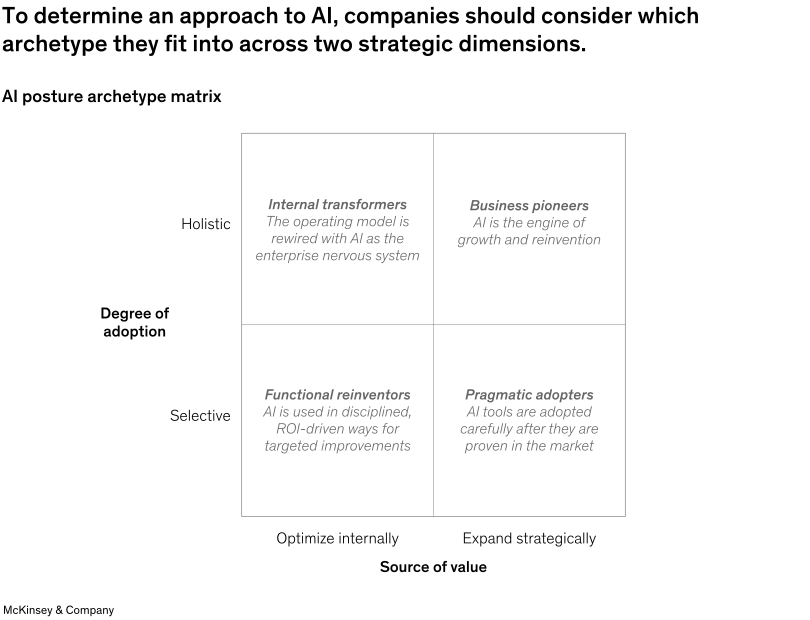
Two strategic dimensions determine a company’s approach to AI, with where companies fall along the spectrum of each defining their posture:
- Source of value. Will AI help the company move beyond its core business model into new products, experiences, and revenue streams (expand strategically), or will its value primarily come from improving the existing model (optimize internally)?
- Degree of adoption. Will AI be embedded across the enterprise (holistic) or applied in targeted use cases (selective)?
A company’s position along these dimensions determines its AI posture (exhibit). Determining which archetype a company wants to pursue is less about precision and more about aspiration. Companies are unlikely to fit neatly into one archetype and may straddle multiple ones—particularly at scale, where different business units or functions may pursue different approaches.
Exhibit
We strive to provide individuals with disabilities equal access to our website. If you would like information about this content we will be happy to work with you. Please email us at: McKinsey_Website_Accessibility@mckinsey.com
What matters is that the board aligns on the business’s aspirational strategy using a clear view of the opportunities and risks so that it can tailor the governance approach. As the business gains greater experience with AI, the board can modify its posture.
The four archetypes are as follows:
- Business pioneers. AI sits at the center of strategy, driving new offerings and redefining competition. Think of a medical-device company that could evolve from selling equipment to delivering AI systems that interpret scans and suggest appropriate treatments, thereby transforming from a manufacturer into a healthcare solutions provider.
- Internal transformers. AI becomes the backbone of operations, reshaping how an enterprise runs. An example of this archetype is a mining company deploying AI to guide exploration, automate extraction, and optimize refining—thereby transforming a labor- and asset-intensive model into a data-driven one. Similarly, a media studio could embed AI across its production pipeline, producing faster, cheaper content at scale.
- Functional reinventors. AI is used to enhance specific workflows with proven returns. Companies treat AI as a disciplined, ROI-driven investment rather than a reinvention lever. As an illustrative example, a healthcare system might adopt different AI scheduling, transcription, and workforce tools. Or a logistics provider could use route optimization and predictive maintenance to cut costs.
- Pragmatic adopters. AI is adopted for targeted applications based on already proven market traction. This is essentially a fast-follower approach. For example, a consumer goods company may wait until off-the-shelf e-commerce recommendation tools have been proved before adopting them to expand to new segments. Similarly, a fashion retailer might start leveraging AI to offer clothing rentals and personalized styling only after others in the industry have proved its effectiveness.